Second Nature:
encourage recycling at work
The Problem
As Seattle residents, my group for this project was familiar with the pride that the city takes in its green practices. Composting has recently become a law here, and yet, we all expressed frustrating with the lack of knowledge around how to sort and dispose of waste properly. We set out to improve adherence to waste regulations.
Our initial design question was: How can compliance with waste guidelines be improved among residents of King County?
However, we quickly learned that this scope was too broad. Ultimately, we sought to answer the following question through our design:
How can a tool encourage Seattleites to recycle more accurately in the office environment?
---
This project was completed as part of coursework for a class on User-Centered Design in the department of HCDE at the University of Washington.
The Research

Persona Quotes
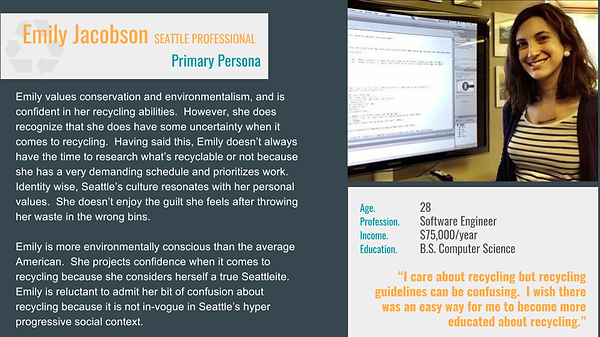
Primary: "I care about recycling but recycling guidelines can be confusing. I wish there was an easy way for me to become more educated about recycling"
Secondary: “I want my coworkers who do not recycle, or recycle infrequently to see how easy recycling can be.”
Tertiary: “Where I’m from, recycling just isn’t that important.”
Research Questions:
-
Do people understand why they should recycle?
-
What stops people from recycling? What motivates them to recycle?
-
Do users understand what they need to do to recycle?
-
What's the current attitude/culture around recycling in Seattle?
Survey. In order to gain insights into a users beyond our immediate network, we design a survey and posted it to Reddit and social media sites. We received a 130 responses. We learned that people recycle because of guilt, social pressure, and environmental responsibility. Respondents indicated that they didn't recycle because they didn't have access or they were unsure about what is and isn't recyclable.
Card sorting. Participants in our card sort were asked to sort photos into the categories "Recycle", "Don't Recycle" & "Not Sure". This method allowed us to watch and listen to the user's thought process as they sorted their hypothetical waste. We learned that our participants were confident in their sorting, but in actuality did not sort all of their waste correctly.
Behavioral Archaeology. To understand the office context, each member of our group took photos of the waste bins in our offices. While the card sort provided insights into how people sort waste when it is presented as a test, it was important for this context to learn how people behave when no one is watching. The results of this method confirmed the basis for our design question; garbage and recycling was commingled in both bins.
Extreme User Interviews. Our survey indicated that Seattle professionals tend to be more extreme when it comes to their recycling attitudes. By conducting interviews with extreme users, we hoped to gain an understanding of what our users would want in a tool, and what motivated them to recycle. Many extreme users would seek out the answer to any recycling questions. However, time and convenience was a still a key factor in the extreme user's decision making. I personally conducted two interviews.
Personas
Personas developed from our research kept our design conversations on course. After developing the content for our personas as a team, I produced the final visuals.
DESIGN

Sketch of barcode scanner integrated into recycling station.

Initial sketch of a mobile app that would allow users to take a photo of an item and search a crowsourced bank of images to discover whether or not it is recyclable.

Final sketch for submission as one of our team's "Top 3 Ideas"
Sketch of barcode scanner integrated into recycling station.
Design Requirements
From our research, we developed a list of design requirements. The tool should:
-
Educate users on what is recyclable, in order to influence their daily habits.
-
Integrate easily into existing infrastructure and routines within the office.
-
Require minimal steps and time commitment.
-
Align with city regulations to present correct recycling rules.
Ideation
To begin our ideation phase, each of us a teammate produced sketches independent from one another. My sketches included a crowd-sourced reference app (an app interface that utilized photo recognition software to match a user's photo to an item's image and it's associated recyclable status), a recycling station with a built-in weight sensor alongside a large digital display to present the rank of the office in a recycling competition, and a barcode scanner recycling station that returned the recyclable status of a scanned item.
The reference app idea was submitted as one of our group's top 3 final ideas.
Ultimately, our team decided on a large interactive display for the office kitchen. The tool would present the recyclable status of items from local establishments. Users could search by item type or restaurant to discover the final disposal location of their waste. We chose this idea because it could be customized to each office, and was specific to the office context, unlike the mobile app.


Paper Prototype
Before moving forward to a medium-fidelity prototype, we created a paper prototype, which I sketched up by hand. This prototype enabled our team to test a task list that made sure we were organizing the pages in a way that users would understand.
User tests of the paper prototype revealed a host of concerns. Primarily, users expected to be able to dive deeper to learn more about a product (by clicking on it), instead of seeing the indication of recyclable/not recyclable as the final step in accomplishing their task.
Final Prototype
As a final step in our process we built a prototype using Axure. The main adjustments we made based on feedback during paper prototype user testing were increasing the size of the recyclable status indicators and changing the scroll to horizontal instead of vertical to accommodate the large touch screen interaction style.

This page categorizes frequently searched waste as recyclable/not recyclable on color coded scrolling strips. The bottom strip shows nearby eating establishments, clicking on one of them will open their restaurant page.

Users can discover what to do with Starbucks-specific waste on this page.

If a user searches for "cup", this is an example of what they might see. They can request that an item be added to the bank of items, if what they are searching for does not appear in the results.
This page categorizes frequently searched waste as recyclable/not recyclable on color coded scrolling strips. The bottom strip shows nearby eating establishments, clicking on one of them will open their restaurant page.
Lessons learned
I took away learnings throughout this whole project. In particular, I learned:
-
That passion works. For this project, each team member could speak to the challenges they had witnessed or experienced around recycling, and we all wanted to solve this problem.
-
The delight of ideation. This group had some crazy ideas, and we decided at the outset to entertain all of them, which pushed us to define what the goals of our tool really were.
-
How to keep our process moving. We would eddy occasionally as a team, and I found myself primarily acting as the person to redirect our focus on the task at hand.
Next steps
The most obvious next step would be to develop this interactive tool, and roll it out to offices around the city. Before doing that, there are some things that would still need to happen from a design perspective. Another round of usability testing would inform changes to the layout and navigation. The tool could also benefit from a visual redesign, initial reactions from classmates indicated that green as the sign for recyclable was confusing with compost being so strongly associated with the color green. Which brings me to the most major of the recommendations I would have for this project's next steps: integrate composting into the goals and features of the tool. To simplify our project for the purpose of the class, we left it out, but it is a key component of our waste system, and, from my experience in the work kitchen, just as poorly understood as recycling.